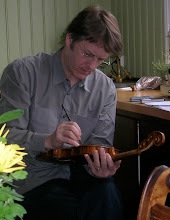
I was fortunate enough to attend the Newark School of Violin Making in the late seventees, in what seemed to be quite a unique period of violin making enlightenment, concerning style and a process of rediscovery of the working methods of the old masters through analysis rather than simple emulation.
However, I felt my training was devoid of real knowledge of the nature of tone.
Some of us at school began doing work on plate tuning. This happened mostly outside the school walls and satisfied some of the curiosity.
Fairly soon, I became less convinced that free plate tuning was relevant to the dynamics of the completed instrument, but in the spirit of agnosticism carried on recording weights and frequencies.
I devoured a plethora of stringed instrument recordings and attended as many concerts as my budget would allow, with the conviction that listening actively, was and still is the key to understanding tone. There was however the perplexing need to associate that tone with some physical aspect of the instrument, other than simply "working in the correct way".
After having worked several years solely making instruments, I began studying the vibrations of my finished instruments. I hijacked some of the tools of plate tuners and started suspending finished instruments over a loudspeaker hooked up to a signal generator. With ear protection I would sweep a sine wave through the body of the instrument, while lightly touching the surface with my fingers. This was a kind of rudimentary analogue modal analysis, at a time when only the scientists did this sort of work. I had seen the diagrams of Marshall in the Catgut journals, so I could envisage basic modal shapes as I felt their presence. I also strewed sawdust onto the surface and in through the f-holes to see nodal lines. I did some demonstrations of this method at the Newark school several years later and showed it to colleagues, and was rather surprised to find that most people felt sorry for me, and that I had veered off the "path".
The limitations of this method are that above around 1000hz there are no readily recognisable modes, as they become a conglomerate of increasingly small and complex movements, also you need some fairly loud sounds to excite the instrument, but the largest contributors to radiated sound are the signature modes and there is only a small number of them.
Today I use modal analysis, with impulse hammer, accelerometers and microphones, to map my own instrument's behaviour and also measure fine instruments that come my way. I am a participant of the Oberlin acoustics workshop and am glad to engage with some peers that I admire there. My local medical clinic has also been very supportive of my CT scanning instruments of calibre.
Of course I also use the very sophisticated technique of biting my wood and throwing it on the floor for the finer assessments.
One thing is certain, and that is that what I have learned through the application of technology has made my instruments sound much better. No doubt.
Is technology always a good thing, or is new technology having a detrimental effect on violin making?
My making is traditional. The tradition is characterised by the thirst for knowledge. Knowledge cannot be detrimental.
Where do you think advances in technology will take violin making? Will it enable luthiers to build the perfect instrument?
Primarily the new knowledge will change the way makers envisage the workings of their instruments. This will lead to potentially beneficial changes. With the most sophisticated scientific methods and machinery , one will however still be able to make an absolutely awful instrument with considerable ease. Intuitive work is an open system, which fumbles a bit in the dark. Science is closed, it affirms or negates. Both are exciting and possibly mutually beneficial, but violin making will not be interesting if it becomes a pure science. Technological advancement in violin making is definitely a speed inhibitor and does not increase production. On the contrary it forces you to put more thought and work into the making.
How has the internet – including websites, email, forums and Skype – helped your making?
Makers are finally engaging in a sharing of knowledge and a tactical discourse in the spirit of openness spurred by the internet.
The net has transformed the world and hasn't excluded the violin makers. Secrets are "passé".
Hans Johannsson